Featured

My First Blog Post

What the top of the page said

Be yourself; Everyone else is already taken.

— Oscar Wilde.

This is the first post ever besides the insta-blog I run. feel free to check it out @on_some_adventure_brb on Instagram! Also, I just started doing Youtube for singing (Youtube: SappireSiren) feel free to subscribe/follow both! Other thank that, you can find out more about me on my “About Me” page. Thanks y’all!

Inquiry Based Learning

So this week we were able to learn about inquiry based learning! How it can be used in the classroom, how much of an impact it has on students’ learning, and the history/revisions made to the theory over the years.

I kind of always knew about inquiry based learning, I just didn’t know it had a name. When I was growing up, I wish more teachers would have implemented this strategy in the classroom, I probably would have done better! But, now that I’m becoming a teacher myself, I’ll be sure to use this strategy in my own classroom to make sure students are learning in the best and most efficient way possible!

Cyber Security!

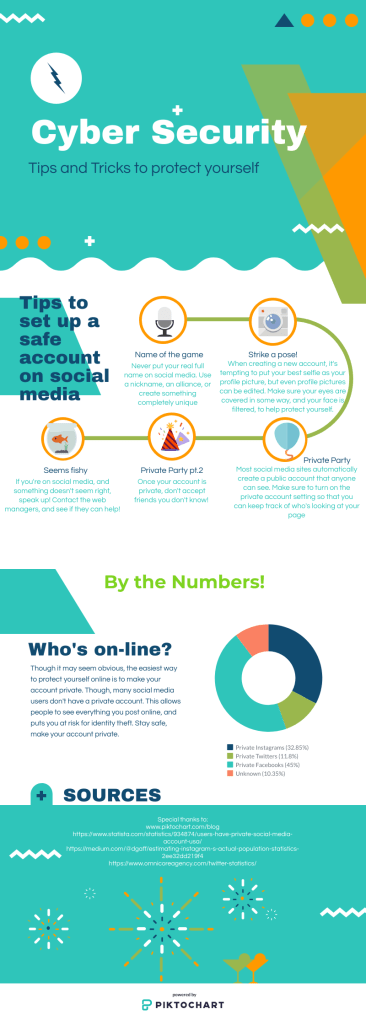
Hey everyone! So this week’s topic was cyber security, and in such a modern era where almost everything is based online, cyber security can be a big issue. However, it doesn’t have to be! There are some simple was you can stay safe online, without going completely off grid.

In this module we also got to look at a video of a USF student who actually experienced identity theft through social media. It’s scary to think that something like this could happen to anyone of us at any point, and others won’t even notice it’s not real. From her story I learned that you can never be too carful online, and that identity theft can happen to anyone using the simplest of tools. It’s sobering.

With the information from the video I can inform others to take probation on social media, even if they think “it won’t happen to me”.

Blog Post 3

Hey everyone! So this week we were supposed to create a Presentation (in power point or Google Slides) and then do a Q&A post! So I did my presentation on Dolphins because I find them fascinating! I’ll post the link at the end of the post, but for now here’s the questions and answers form this week’s discussion.

1. What two suggestions from the readings about how to use PowerPoint effectively do you think are the most important to remember? Why?

  • The first suggestion that I remembered was to not over use animation, because I have a tendency to do that with power point. I think ‘oh it’s fun! it’ll grab people’s attention!’. And while it does do that, I can’t over use that creative power. Another suggestion I remember is make sure your audience can read your slides! I struggle in this area as well for the same reason. I want my presentation to be colorful, and I wind up having it be unreadable. I’ll work on it.

2. What is one thing you learned about PowerPoint that you didn’t previously know?

  • One thing I found out about power point was that you can animate audio and picture files. I didn’t know you could do that before!

3. Have you ever used PowerPoint to present and what was your experience like? Did you follow the rules to presenting with PowerPoint or not?

  • I’ve been using power point for a while so I’ve become really good at it, but I did find out the Google Slides and PowerPoint are two very different programs. I much prefer Power Point because, in my opinion, it’s easier to use and upload content to. As far as keeping to the rules, I find them to be more like guidelines, but I try my best to follow them.

4. How was your experience creating your Museum Kiosk on Google Slides?

  • Like I said, I found Google slides much more complicated than PowerPoint, however, it was easier to present it to others than a power point would be. 

Assignment 2: Maslow and Bloom

This week we learned all about Maslow’s Hierarchy of Needs as well as Bloom’s Taxonomy of Learning Domains, and I couldn’t have been more excited! This lesson parleys directly into my major and I already had a lot of background knowledge about the topics, which made it easier to read and understand. However, I did find that Maslow’s theory was the simpler of the two concepts, whereas Bloom’s theory took me a couple of reads to figure out.

For those who don’t know, Maslow’s Hierarchy of Needs is basically a theory on the perfect human existence. It personifies the need of each individual in order to feel secure in themselves and their surroundings. The first tier is Physical Needs such as food, water, air, and shelter, the basics. Then as we move up the pyramid, we get to Safety, which can translate to employment, personal security, health, and resources in general. The next tier in Maslow’s hierarchy is Love and Belonging, which is where most people tend to get stuck for a bit, especially in college. As a transfer, sophomore, in college, whose moved four times in the past three years, I can safely say that this zone is probably one of the hardest to find/accept. But, finding clubs that I enjoy, making new friends, and getting out in general helps me as well as others find that sense of belonging. After belonging, comes esteem, another tier people easily get lost in. Esteem is about respect, status, self-esteem, freedom, and most other concepts along those lines. Again, as a college student, it’s easy to doubt yourself in multiple aspects of your life. My suggestion is, if you’re feeling down on yourself, make a list of everything you love about yourself, and that you’re proud of. Keep that list handy, and whenever you down, look at the list to remind yourself what an amazing person you are. The final tier in Maslow’s Hierarchy is Self-Actualization. This tier as all about being the best you that you can be.  It’s the motivation to keep improving yourself, and the drive to keep moving forward in every aspect of your life.

While Maslow’s theory is more about life in general, Bloom’s theory is more education based. While the original theory was ordered, Knowledge, Comprehension, Application, Analysis, Synthesis, and Evaluation, it has since been reformulated to Remembering, Understanding, Applying, Analyzing, Evaluating, and Creating. In my opinion, the new domain more properly illustrated the original function of the theory which was to go further than simply memorization of  information. The process of taking the information and applying it to everyday life is, in my opinion, a more valuable skill than memorizing, regurgitating and forgetting the information. Bloom’s theory also explains the three domains of learning which are Cognitive, Affective, and Psychomotor. The Cognitive domain focuses on mental skill, the Affective domain focuses on growth of emotion and feeling, and the Psychomotor domain focuses on manual or physical skills. All of these skills combine allow a person to grow to their fullest both academically, and non-academically. 

Maslow’s and Bloom’s theories both complement each other in that both theories want to help individuals (in this case students) to have their best life possible. It is my personal opinion that you cannot have one without the other, as each explains a different aspect of life. Without both Bloom and Maslow, education would not be where it is today.

Assignment 1: First Real Post

For this week’s lesson, we as a class were tasked with learning the idea behind modern technology.  The way I see it, it all started with Moore’s Law. Moore’s Law explains that technology would continually grow faster, stronger and more portable, while also decreasing in size. This law was presented by Gordon Moore, one of the co-founders of Intel. His law was first presented in a magazine article in 1965, and has been proven over and over again. Each year companies like Google, Apple, Intel, and so many more are coming up with ways to make life easier, smarter, and faster, all while fitting in the palm of our hands. 

The size and geometry of technology, however, navigates us towards a scientist named  Buckminster Fuller. Fuller was an inventor who’s basically responsible for the E.P.C.O.T ball. He coined the phrase “Spaceship Earth” and his geometric and streamlined designs have been implemented throughout the world for cars, military houses, and even children’s jungle gyms. He is most famous for his geodesic dome, which we see examples of almost everywhere. His idea that we can pull from nature’s design to create better functioning structures is what prompted the idea “Spaceship Earth”. He also proposed the Dymaxion Forum, which explains that to move forward, we have to look back to see where we came from. Hence the theme of the ride, “Spaceship Earth.” By allowing ourselves to look back on what worked, and what didn’t work,  we can pull from and work off of the ideas of previous inventors and propel ourselves into almost a completely new world.

 The prediction of a new world brings us to an author by the name of Ray Kurzwell. Kurzwell “has received 20 honorary doctorates, has been awarded honors from three U.S. presidents, and has authored 7 books (5 of which have been national bestsellers)”, and has somehow predicted, almost to the date, how the world would change with the advancement in technology. He estimated the time frame of advances such as wireless voice command, the evolution of artificial intelligence, and the overall capacity of the humane brain. He also predicted innovations like “Siri” and “hey Google” all the way back in 1999. And while these things have made life easier for most of us, it begs the question of “is it too much?” and “Does Technology have too much control?” Thankfully, Kurzwell doesn’t believe that this is the case, and believes each new technology should be shared with the world to make the world a better, smarter, place.

These laws and predictions have been proven time and time again, but still some sceptics say that you can only fit so much power in to such a little chip/processor. Peter Theil is one of these nay-sayers. Theil is a billionaire who made his fortune with the invention of PayPal which he co-created, and by being a major investor in the social media platform Facebook. Even with his influence in today’s technology, Theil is of the belief that innovation has plateaued. His famous work “We wanted flying cars, instead we got 140 characters” is a reflection of this belief. According to Theil, in the past there was immense room for improvement in many areas including Government, Technology, automobiles and more, however we as a society has adopted the notion to “just do things a slightly better than the people around you”. Which in a way is correct because things have gotten so much better than they were originally,  the margin for improvement is small. As well, in areas such as Sea travel, energy, and space travel, Theil is mostly accurate in saying that there hasn’t been much progress in those areas unfortunately. 

While there are some differences in these authors opinions, most of them agree that advancement in technology would make this world a better place. The discrepancies come in when you look at the time. Moore believes that advancement is ever growing, and hopes never stops, Fuller thought that to move forward we have to literally stop and smell the roses, Kurzwell is really good at predicting the future somehow, and billionaire Theil believes that technology has reached its peak and now remains stagnant into the future unless we try something completely new. In some ways, however, they’re all correct. They are all correct in saying that technology has changed our lives and where we go from here is still to be seen. 

My take on all of this is that, they’re not thinking big enough. Sure, we can climb Mt. Everest from the comfort of our own couch using AR, but what if we used similar technology to allow people with depression to see a person they’ve lost once again? Or what if we invented a Nano-bot that eliminates cancer cells? Of course allowing everyone to enjoy new technology is great and fun, but people are using it to be lazy, not to make the world a better place. So, yes, technology is changing the world like we wanted, but it’s not changing it enough. 
Design a site like this with WordPress.com
Get started